
5 min read
Why Thought Leadership Matters More in AI Search
Something fundamental has shifted in the way people find information, and most small businesses have not yet caught up to what it means for their...

3 min read
Jen Best
:
Updated on June 10, 2026
A few months ago, a business owner I work with Googled their own company and found it. Great. Then they asked ChatGPT the same question a customer might ask when looking for a service like theirs. Their business didn't appear at all.
That gap, between existing online and actually being found, is one of the most important visibility problems business owners are facing right now, and most of them don't know it exists yet.
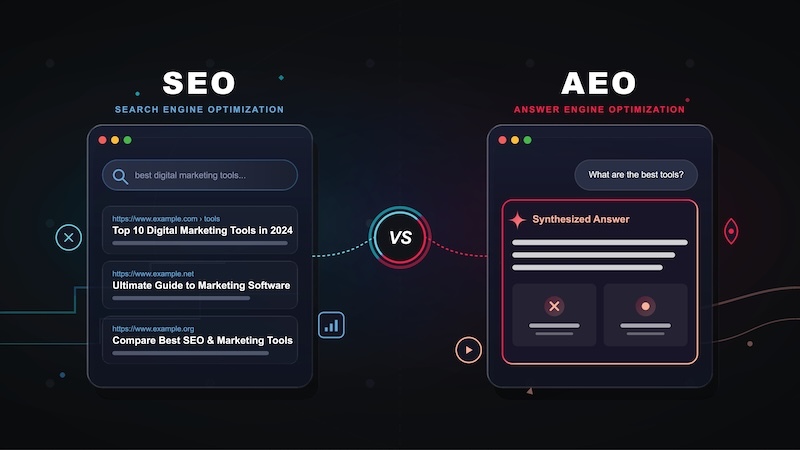
We're in the middle of a real shift in how people search. More and more people are starting their searches inside AI tools like ChatGPT, Perplexity, Claude, Google's AI Overviews, and others. These tools don't return a list of ten blue links. They synthesize an answer, and they either include your business in that answer, or they don't.
The rules for getting included are different from traditional SEO. And that difference matters.
AEO stands for Answer Engine Optimization. It's the practice of structuring your online content so that AI-powered search tools can find it, understand it, and use it when answering relevant questions.
Traditional SEO (Search Engine Optimization) is built around keywords and links. You optimize your pages so search engines rank them for specific search terms. Search engines then list the top pages with links back to each site that is the most optimized for that search term. Over the years, Google has gotten much better at seeing past the old SEO hacks and now does a much better job understanding the content and context of a website, which has led us to where we are in search today.
AEO is built around answers. The focus becomes more narrow: when someone asks an AI a question that your business could answer, does your content surface as a credible source? And, since Google launched their AI-first search box in May of 2026, we can include Google as important in your AEO strategy too.
GEO, or Generative Engine Optimization, is closely related to AEO. You might also hear it described as AI Optimization. It refers to how you show up specifically in generative AI outputs, like the summaries Google now shows at the top of most search results. GEO results may include summaries with or without brand citations and links, depending on the topic and AI platform. This means your brand or content may show up in an AI overview with or without your brand being linked.
You don't need to master the technical details to start moving in the right direction. You need to understand a few core principles and take some practical steps.
If you've invested in traditional SEO, building backlinks, optimizing title tags, targeting keywords, that work still matters. It's not wasted. But AI search tools pull from a wider set of signals than a standard search engine does.
They're looking for content that clearly and directly answers specific questions. They favor sources that demonstrate credibility and expertise on a topic over time. They pay attention to consistency: does your website say the same things about what you do as your Google Business Profile? As your LinkedIn? As your social media?
They also pay attention to how often your business is mentioned by others, in local directories, in articles, in reviews, as a signal of credibility.
You don't have to be a marketing expert or web developer to start understanding how to optimize for the AI engines. The more familiar you become with how they work and provide responses, the more prepared you'll be to understand how they'll likely present your website in overviews.
1. Ask ChatGPT and Perplexity about your business category.
Open ChatGPT (free version is fine) and type a question your ideal customer might ask, something like "Who are the best [your service] providers in [your city]?" or "What should I look for in a [your type of business]?" See what comes back. Note whether your business appears, and if not, which businesses do.
This is your baseline. It's not a definitive audit, but it tells you something about where you stand right now.
2. Check your Google Business Profile.
This is one of the most consistently under-leveraged assets small business owners have. Log in at business.google.com and make sure your profile is complete: accurate hours, correct categories, recent photos, and a description that clearly explains what you do and who you serve. Google's AI Overviews pull heavily from this data. If you don't have this set up yet and you need help, let's talk.
3. Add a FAQ section to your website.
Pick five to ten questions your customers actually ask you, the ones that show up in your inbox and in sales conversations. Write clear, direct answers. Format them as actual questions and answers, not buried inside a paragraph. AI tools respond well to this structure because it's already answer-formatted.
4. Get consistent across platforms.
Your business name, address, phone number, and service description should say the same thing everywhere they appear: your website, Google Business Profile, Yelp, LinkedIn, your local chamber directory, wherever. Inconsistency confuses both search engines and AI tools. Consistency signals credibility.
AI search isn't going away, and it isn't slowing down. The businesses that start building these habits now, even imperfectly, will have a real advantage over the ones that wait until it's obvious they've fallen behind.
You don't need to overhaul your entire digital presence. You need to start with clarity: clear answers to the questions your customers are already asking, consistently presented across the places your business lives online.
That's the foundation. Everything else builds from there. And, stick around for more tips and topics on AI optimization for your small business.
5 min read
Something fundamental has shifted in the way people find information, and most small businesses have not yet caught up to what it means for their...

4 min read
If you’re a small business owner, there’s a good chance you started out doing your own marketing. You wrote the first version of your website.You...
4 min read
There is a story that has been circulating in marketing circles for the past two years, and it is causing a lot of unnecessary anxiety. The story...